Movies have always contained hints of representation for people in minority populations. Granted, it isn’t always good, and in fact, the vast majority is awful, full of stereotypes and tropes that cause a great deal of harm to the images of the groups they portray. The documentary “The Celluloid Closet”, directed by Rob Epstein and Jeffrey Friedman, sheds light on the history of homosexuality and non-gender conforming representation in film, discussing it’s range from positive to positively harmful.
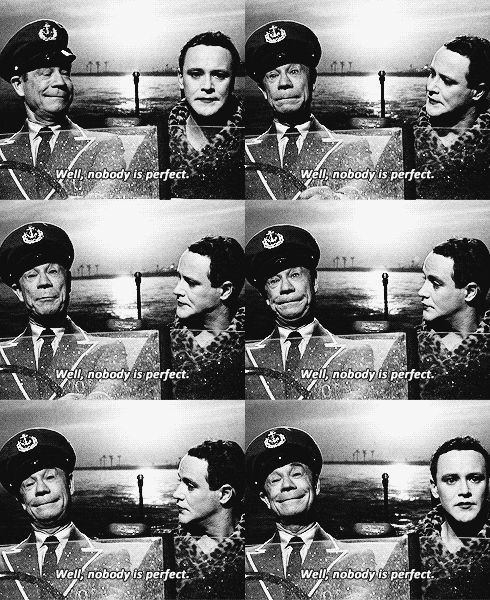
I was shocked by the amount of homosexual content in film early on, even if it was used for comedy and mockery, I hadn’t realized it was shown on the silver screen so early. The prevalence of homosexual characters in silent films, though clearly caricatures, was far more than I had been expecting. My prior knowledge had only extended to comedic aspects like one famous scene in the film “Some Like it Hot,” in which a man pretends to be a woman, and the man who tries to marry him only proclaims that “nobody is perfect.”
I am likely not alone in my view that positive visibility is preferable, but I can see how, in desperation to see someone who is like ourselves, a person might say, “my view has always been visibility at any cost. I’d rather have negative than nothing.” This struck me in the film. For years the LGBTQIA+ community has reached for anything it could get, whether it be gay and lesbian subtext, or interpreting characters and even actors, like Charlie Chaplin, as trans. When something is explicitly stated, it’s seen as amazing, even if it’s a villain, someone truly despicable. The film discussed the violence inspired by “Cruisin,” another negative outcome of the way films treated homosexuals as victims or perpetrators of violence.
I was honestly surprised as the movie progressed, as I discovered how many examples of homosexuality and gender non-conformity I had never seen, or been made aware of. There were so many varied films, and I hadn’t seen any of them. I knew there were tropes regarding “sissies” and killing gay characters, but I hadn’t realized how prevalent they truly were. I hadn’t realized how many good gay stories there were.
This isn’t to say that the films were perfect, and many of them were very, VERY flawed, but there was so much gay content I hadn’t known about. Of course, there’s more to do, even with regard to where we are now. Everything I had heard in the film was something I could apply to today, even though it was made well before gay marriage was legalized, before significant changes had been made in regards to gay rights and freedoms, when the LGBTQIA+ community is loud and proud, even though we still face significant opposition. There’s still so much to fight for in representation.
Now we have queer baiting to contend with, with production of media that hints toward representation without intending to pay off, to bring in queer audiences without alienating their hetero-normative audiences as well. We get far more queer-coding, but still have to fight biases to force the subject from subtext into the light.

 Film, Gender, and Sexuality
Amy,
I completely agree with everything you say here. It was shocking to me how early on there was LGBTQ+ representation in film. As you mention, a lot of it was negative which is not good, but I was still amazed that it was there at all.
I do also see the appeal for any representation, even negative, in a time where there was very little, but I do not really agree with it. While I do not identify with the LGBTQ+ community, if I did I think I would prefer no representation as opposed to negative, because then it creates false expectations for people who are ignorant of the truth. In the long run, the wrong knowledge can do a lot more harm than no knowledge.
LikeLiked by 1 person